
This Isn’t About Trump — It’s About the Emotional System We’ve Been Living Inside
Escalation Has a Shape: How EPI Mapped 10 Years of American Rhetoric
Most people think escalation is sudden. A blow-up. A riot. A breaking point. But escalation doesn’t begin with violence. It begins with tone- long before anything dramatic happens.
It begins in the emotional undercurrents of language: fear, threat, grievance, hostility, savior narratives, identity distortion.
The truth is simple:
Escalation is not an event. It’s an architecture. And for the first time, we can actually see it.
That’s what Emotional Pattern Intelligence (EPI) was built to detect.
What EPI Actually Reads (And Why That Changes Everything)
EPI doesn’t analyze politics or personalities. It analyzes patterns inside language itself — the emotional patterns that rise, repeat, intensify, and harden over time.
It reads three things:
1. Tone Patterns
Not “angry” or “fearful,” but the micro-signals inside harmful communication:
dehumanization
catastrophic stakes
moral superiority
threat inflation
mobilization cues
victimhood → entitlement shifts
2. Relational Dynamics
Not what someone says, but how they position groups and institutions:
who is “us”
who is “them”
who is blamed
who is trusted
who becomes a threat
who becomes a savior
3. Escalation Architecture
The deeper structure beneath the rhetoric:
grievance →
delegitimization →
mobilization →
crisis framing →
identity fusion →
action cues
This architecture is what drives abusive relationships, extremist movements, cult dynamics, authoritarian messaging, and political unrest.
Until EPI, this structure was invisible. Now, it has a shape.
What I Studied
I spent weeks mapping ten years of Donald Trump’s public rhetoric, from 2015 through December 2025, through the EPI lens.
Not to judge him.
Not to diagnose him.
Not to speculate about motives or outcomes.
But because his rhetoric is:
public,
voluminous,
consistent, and
emotionally patterned over a long period of time.
It is the clearest dataset in modern American political history for studying escalation as an emotional system.
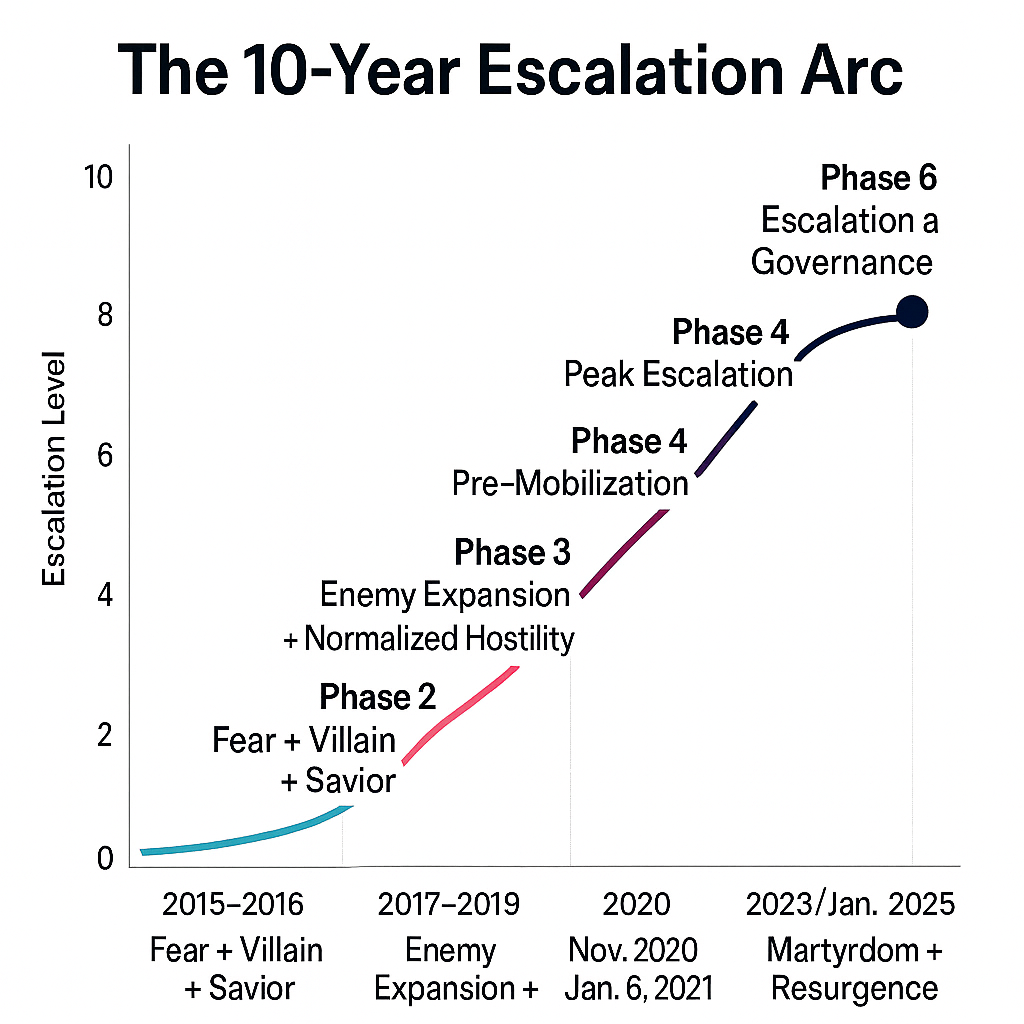
When the decade was laid out, the pattern wasn’t chaotic at all.
It was a staircase.
Predictable.
Structured.
Progressive.
And escalating the entire time.
Here’s the map.
THE ESCALATION ARC — 2015 to 2025
PHASE 1 — 2015–2016: Fear + Villain + Savior
Escalation Level: 2.5–3.5 / 10
This is where the emotional blueprint begins:
outsiders as threats
institutions as corrupt
the leader as the singular solution
This is the classic opening of an escalation system.
It establishes the emotional dependency that everything else builds on.
PHASE 2 — 2017–2019: Enemy Expansion + Normalized Hostility
Escalation Level: 4.5–6 / 10
The threat universe widens:
media = enemy
protesters = enemy
entire racial and national groups = enemy
judges and agencies = suspect
Fear was no longer the point.
Separation was.
This phase creates the “us-vs-them” world that future escalation depends on.
PHASE 3 — 2019–2020: Pre-Mobilization
Escalation Level: 6.5–8 / 10
Fear turns into readiness.
“LIBERATE Michigan!”
“The only way we lose is if it’s rigged.”
“Stand back and stand by.”
This is the emotional tightening of a system preparing for crisis.
PHASE 4 — Nov 2020 to Jan 6, 2021: Peak Escalation
Escalation Level: 9–10 / 10
Everything that had been built becomes activated.
“Stop the Steal”
“Fight like hell”
“Show strength”
“You won’t have a country anymore”
This is not spontaneous chaos — it is the activation of a complete escalation architecture built over five years.
PHASE 5 — 2023–2024: Martyrdom + Resurgence
Escalation Level: 9–10 / 10 (sustained)
Legal pressure reignites the architecture.
“Witch hunt”
“Political prisoner”
“Corrupt system”
escalating attacks on judges and agencies
His suffering becomes the new emotional engine.
This is the identity-fusion phase common in high-intensity group dynamics.
PHASE 6 — 2025 (Present): Escalation as Governance
Escalation Level: 9.5–10 / 10
The architecture no longer operates from campaign rallies.
It operates from the White House.
intensified dehumanization
aggressive immigration rhetoric
hostile foreign-policy language
attacks on the judiciary
governance through grievance, threat, and identity
Escalation is no longer a style.
It is a state posture.
What This Architecture Mirrors (High-Control Groups & Radicalization Cycles)
Not a label — a pattern match.
When I compared the 10-year arc to documented high-control group dynamics and radicalization cycles, the parallels were unmistakable:
outsider threat → “we’re under attack”
lone savior → “only I can fix it”
enemy expansion → “everyone is lying to you but me”
reality replacement → closed information loops
delegitimization → attack on courts, media, elections
mobilization → “fight,” “take back,” “show strength”
martyr identity → the leader’s suffering becomes sacred
This doesn’t make Trump a cult leader.
And it doesn’t make supporters a cult.
It means the emotional architecture follows the same laws of escalation seen across domains.
That's why the system keeps intensifying.
Escalation is a physics, not a personality.
What This Architecture Tends Toward (2026–2028)
Trajectory classes, not predictions.
EPI doesn’t predict actions.
It identifies the directions these emotional systems naturally move toward when uninterrupted.
There are three:
CLASS 1 — Entrenched Escalation
The architecture keeps deepening:
more enemies, higher stakes, more identity fusion.
CLASS 2 — Brittle Overload
The architecture strains against reality:
fractures, paranoia spikes, internal blame emerges.
CLASS 3 — Contained Escalation
The emotional system remains intense,
but institutions and people develop boundaries:
pattern literacy, civic guardrails, emotional inoculation.
EPI does not choose the class.
We do.
Why This Matters — And What We Do Now
Interrupting a system this entrenched takes more than facts.
Escalation doesn’t moderate on its own.
It doesn’t burn out.
It doesn’t soften in power.
It strengthens.
It spreads.
It embeds in identity.
And we’ve spent ten years living inside a system designed to escalate — without ever being shown the architecture underneath it.
But here is the hopeful part:
Escalation can be built. Which means escalation can be interrupted.
Not by shaming people.
Not by arguing facts louder.
Not by trying to deprogram anyone.
We interrupt escalation by:
seeing the pattern
naming the structure
understanding the emotional laws
refusing to be pulled into the nervous-system hijack
building healthier emotional infrastructures around it
That’s the role of EPI.
Not to predict the future.
But to illuminate the emotional physics shaping it.
A democracy is only as stable as the emotional patterns inside it.
For the first time, we can measure those patterns.
We can map them.
We can teach people to recognize them.
We can build safeguards around them.
Escalation isn’t destiny.
Escalation is design.
And now that we can see the design…
We don’t have to walk its path blindly anymore.